Friday, March 12, 2010

Warm Waters Of Hawaii vs. Cold Waters Of California

While Penny Palfrey will swim from Oahu to Kauai in water between 72-74°F (22.2-23.3°C) for an estimated 30-40 hours, Karen Rogers will swim in water in the low 50's (10-12°C) in her 30-mile (48K) swim from the Farallons Islands to San Francisco and Jamie Patrick will swim in low-60's (15-17°C) in his unprecedented 66-mile (106K) triple crossing of Lake Tahoe.

Whether the water is 10°C, 15°C or even 22°C, it can feel cold when you are swimming for that long.

With a nice kick-off with three successful swims in the Cook Strait already by Michelle Macy, Steve Junk and Emily Morris - and many more great solo swims and races scheduled, 2010 is shaping up to be the greatest year in the annals of open water swimming history.

Copyright © 2010 by Steven Munatones

Stars Are Lining In At The Ocean Racing World Championships

Michael Zoetmulder, founder of the 2K Ocean Racing Series World Championships, the Nelson Mandela Bay Bell Buoy Challenge and the King of Nelson Mandela Bay events, is bringing in some overseas stars to his events.

Besides Petar Stoychev, there will be some real fire power on the women's side showing up in Nelson Mandela Bay.

The 2K Ocean Racing Series World Championships on April 3rd will kick-off the festivities at the Nelson Mandela Bay Splash Festival. The next day on April 4th, the stars will compete in the 7K Nelson Mandela Bay Bell Buoy Challenge with a cash prize pool of R33,000 (US$4,463). The 3-day series culminates on April 5th with the King of Nelson Mandela Bay, a unique, exciting elimination event for men and women where the athletes sprint race after race until the King and Queen of Nelson Mandela Bay are crowned and the cash prize purse of R29,000 (US$3,922) is distributed. The King of Nelson Mandela Bay event also includes a development 1K ocean swim for future ocean swimming royalty.

The 2K Ocean Racing Series World Championships is open to all swimmers who will be able to swim against the world's best. The 20 best swimmers will compete in five heats. At the end of every heat, the last four swimmers to cross the line are eliminated. After a short 2-4 minute rest between each round, the next heat will begin. At the final heat, the remaining four swimmers will sprint for the top three cash prizes.

Tactically, the race favors swimmers with endurance, strategic nerve, patience, body surfing abilities and sprinting speed.

Copyright © 2010 by Steven Munatones

Thursday, March 11, 2010

2010 Laureus Award Goes To Natalie du Toit

Natalie du Toit won the 2010 Laureus Disability Award at a star-studded ceremony yesterday. Natalie, who placed 16th in the Olympic 10K Marathon Swim at the 2008 Beijing Olympics and won five gold medals in the 2008 Paralympics, is one of only five athletes to have competed in the Paralympics and Olympics.

An award well-deserved for one of the world's true heroines who truly is an inspiration for all individuals from every walk of life.

Copyright © 2010 by Steven Munatones

Open Water Swimming In College

A new 10K open water race will be added to the official swimming schedule at the International University Sports Federation's (FISU) World University Games.

Given the fact that most of the world's top open water swimmers are currently between the ages of 17 - 26 (with the exception of a pair of German world champions Thomas Lurz and Angela Maurer), the World University Games 10K will most likely become one of the top three most competitive 10K races in the world, nearly on par with the Olympic 10K and the World Championship 10K races.

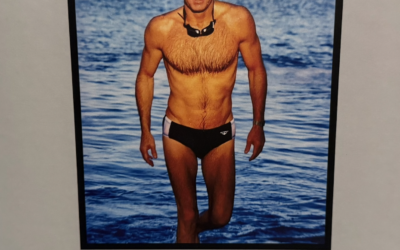
Rick Walker of Southern Illinois University (coach of Kirsten Groome and Mazen Aziz), Tim Murphy of Harvard University (shown above, coach of Alex Meyer) and Jim Richardson of the University of Michigan (coach of Emily Brunemann and Emily Hanson) are examples of three established college coaches who actively support their pool swimmers to compete in the highest echelon of competitive open water swimming.

But with the addition of the World University Games 10K, there will undoubtedly be more college coaches following the footsteps of these trailblazing coaches.

Copyright © 2010 by Steven Munatones

A Difficult Balancing Act

Lewis Pugh is doing a lot of balancing for his upcoming swim on Mount Everest at 17,000 feet where he will attempt to swim a mile in a lake created out of melting glacial ice.

He explains several key issues that he must take into account and walk a fine line.

"First, I must gain more weight to handle the extreme cold of the glacial lake, but not too much – as I still have to walk up Mt Everest. At the moment I am spending about 50% of my time hiking up mountains and 50% of my time swimming.

"Secondly, the longer I spend walking up Mt Everest, the better I will acclimatize to the altitude. Slow is good when you walk up a big mountain. I am planning to spend three weeks acclimatizing. But the longer I acclimatize, the less physically fit I will be [for swimming]. I will not have swum for three weeks prior to the big day – which is not ideal."

"Third, when you undertake a swim to draw attention to an environmental issue – you have to balance training with publicity. Three or four hours of every day is taken up with press interviews – which is time away from the mountain and the sea. But it is vital for me to tell the story to the world’s media."

"And lastly, when you undertake such a dangerous swim, you have to balance courage with safety. There comes a time when you can not make the swim any safer – and you just have to have the courage dive in and trust your team. My support team is headed by Major General Tim Toyne Sewell, the former Commandant of Sandhurst, the British Army Officer Training School – so I am in the best possible hands."

What choices does Lewis face: Plumping up for the water or slimming down for the hike up. Promoting the swim or training for it. Courage vs. safety?

But Lewis has confidence in his preparation, "Training is going on well. I am doing lots of speed training. And I am bulking up nicely – I am now 98 kg. I hope to be around 105 kg by the time of the swim in two months time. This is important as the water will be just above freezing."

Copyright © 2010 by Steven Munatones

Wednesday, March 10, 2010

Clear Water Swim Series In Florida

Bev Buysse announced Clearwater Florida's new Open Water Swim Series for masters swimmers 19 years and older.

The three 1-mile races will be held on May 29th, June 19th and July 17th at the Clearwater Community Sailing Center in the beautiful Clearwater Harbor.

Proceeds from this new Open Water Swim Series will benefit the Youth Programs at the Clearwater Community Sailing Center.

Copyright © 2010 by Steven Munatones

Open Water Swimming Collegians

In very exciting news, the International University Sports Federation (FISU) announced the addition of a 10K open water swimming event to its Summer Universiades competitions.

The first 10K swim will be held at the 2011 Summer Universiade in Shenzhen, China.

Bill Wadley, Men's Swimming Coach at Ohio State University, as the new FISU Technical Swimming Chair, will have responsibility over the pool and open water competitions at the Summer Universiades (World University Games).

Given the fact that most of the top open water swimmers are currently between the ages of 17 - 26 (with the exceptions of the German world champions Thomas Lurz and Angela Maurer), the addition of a 10K race at the Summer Universiades will add another great international competition to the global schedule.

Copyright © 2010 by Steven Munatones

Open Water Swimming Up In The Majestic Mountains

The 2010 US Masters Swimming 6K Open Water National Championships will be held in Lake Water Valley in Windsor, Colorado on June 19th.

Hosted by the Air Force Aquatics Masters, the masters swimmers will compete over a four-loop 1.5K course in Lake Water Valley, located 60 miles north of Denver.

Swimmers can breathe to their left going out and to their right coming back in to capture majestic views of the towering Rocky Mountains.

Copyright © 2010 by Steven Munatones

Filming From The Farallones

Karen Rogers swim from the Farallon Islands to Aquatic Park will be filmed by Roger Teich and Elizabeth Pepin Silva.

Roger previously filmed an equally courageous Ron Elliott who is the only sea urchin diver who works off the Farallon Islands where he shares the ocean with the Great White Sharks.

Roger's riveting footage of Ron's work - right where Karen will be swimming - is below.

Elizabeth is a prolific and award-winning filmmaker well-known for her photography in the surfing world and inspirational filmmaking of female athletes.

Roger and Elizabeth will undoubtedly be able to paint an incredible picture on the canvas known as the Pacific Ocean.


Copyright © 2010 by Steven Munatones

Tuesday, March 9, 2010

Pulling For Penny

We will be in contact with Penny Palfrey's team as she attempts what is touted as one of the most incredible open water swims in history, an incredible 72-mile swim between the islands of Oahu and Kauai in Hawaii in late April.

People around the world will be pulling for Penny as she is escorted by Captain Don Jones and a talented support crew aboard the June Louise.

Copyright © 2010 by Steven Munatones

Documenting Open Water History In The Farallons

Karen Rogers, undoubtedly one of the most courageous adventurers in the world today, will attempt to the first person to swim from the rugged Farallons to Aquatic Park in San Francisco. Her trailblazing effort comes 43 years after Stuart Evans and Ted Erikson made the first and only crossings from the Farallons in 1967

Her attempt will be the subject of a full-length documentary and a PBS television special to be aired later.

Whether on film, on television or in person, Karen's swim will be something spectacular to watch. Besides the upsprings of frigid water that surround the Farallons, a group of islands 43K (27 miles) west of the Golden Gate Bridge, a healthy community of a variety of seals and sea lions attract a large number of whales of various sorts and predatory Great White Sharks to the Farallon Islands.

Karen will not be wearing a black swimsuit on her journey.


Copyright © 2010 by Steven Munatones

Ivy Champion Heads To California For A Trip to Quebec

Harvard University senior Alex Meyer of Ithaca, New York won three events at the Ivy League Swimming Championships and was named Swimmer of the Meet.

Alex will prepare for the upcoming NCAA Swimming Championships as well as the 2010 USA Swimming National Open Water Swimming Championships in Long Beach, California where he will be one of the 10K pre-race favorites along with Fran Crippen, a recent FINA World Cup winner and 2009 World 10K Championship bronze medalist.

The top two finishers will qualify for the 2010 World Open Water Swimming Championships in Lac St-Jean, Canada in July.

Copyright © 2010 by Steven Munatones

Channel Season Starts Off Nicely In The Cook Strait

Reports in from the Cook Strait that the channel swimming season got off to a roaring start in 2010 with three successful swims in Cook Strait over the last 48 hours. Michelle Macy and Steve Junk plowed through rough seas to finish in slightly over 8 hours. With the incomparable Philip Rush at the helm as coach, both Michelle and Steve were in good hands.

"The waves seem to bump me in every direction (near the finish)...with the winds (up) to 15-17 knots, it was causing a lot of chop and some white caps. The sun was out which created a warming sensation on the back and the water was a really nice temperature. There was no real sea life to speak of, but I really was hoping for the dolphins that Philip and Mike talked about. Just a few odd jellies and some kelp and that was it," wrote Michelle on her blog.

The dual crossing was followed by Emily Morris' 9 hour and 58 minute swim. Emily, a guide with SwimTrek and reportedly the first British woman to cross from South Island to North Island, did the swim to help raise funds for a disabled chair hoist for the YMCA London South West and Hampton Pool Trust.

With more people attempting the Cook Strait, the Strait of Gibraltar, the English Channel, the Catalina Channel, the Tsugaru Channel, the Molokai Channel and many other swims before in open water swimming history, the success of Michelle, Steve and Emily bode well for the rest of the community.

Copyright © 2010 by Steven Munatones

Monday, March 8, 2010

An Endurance Athlete's Oasis In The Desert

Sometimes you just walk into a location or venue and know are you are in the right spot.

Like an actor with that special charisma or that piece of artwork with that special "it", when you see it, you know that you have entered somewhere extraordinary.

Tennis has it with Wimbledon. Golf has it with Augusta. Surfing has it with Mavericks or the North Shore. Marathon swimming has it with Dover and Aquatic Park.

We think we found it in the world of triathlon retail.

TriSports, located in sunny Tucson, Arizona, is the epitome of a great bike, running and swimming shop with a friendly and experienced staff of triathletes, cyclists, runners and swimmers.

We were especially impressed with the TriSports double Endless Pools where athletes can test swimwear and wetsuits at the shop and then make a decision on what swimwear is optimal for them.

Supported by Olympic medalists, then shop is an oasis in the desert for endurance athletes.


Copyright © 2010 by Steven Munatones

Sunday, March 7, 2010

Crossing From Oahu To Kauai With The June Louise

Penny Palfrey gave some additional insight into her 72-mile swim across the Kaieiewaho Channel between the islands of Oahu and Kauai. "My escort boat pilot is Captain Don Jones who lives on Kauai. He runs a charter fishing boat, the June Louise, and will be in touch with the local fishermen to get as much information about the currents as possible before and during my swim."

"I hope to begin my swim in the morning sometime, so I’m able to get a night’s sleep before the start. The exact time will depend on the day we swim and what the tides are doing on that day. I’ll be taking advice from Captain Don and my crew."

Her crew will include Forest Nelson, Bill Goding, Neil Vaughan, Jeff and, possibly, her husband, Chris - who will be attempting his own difficult swim in the Molokai Channel that same week.

Penny will certainly be in excellent hands.

Copyright © 2010 by Steven Munatones

Macy Swims From The English Channel To The Cook Strait

Reports from Michelle Macy that she was given the go-ahead from Philip Rush to begin her Cook Strait swim on Monday.

Although confident from her training and based off of her 2009 English Channel success of 11:37, as she - and every marathon swimmer - knows and prepares for...she will expect the unexpected.

"In the two days that I've been in New Zealand, particularly Wellington, I've found the weather to be particularly unpredictable. The winds can come from nowhere," said Marcy. "We went to Te Papa for a quick look around and found the Maori heritage section where we found a lot of the ceremonial instruments. I quickly found the one that is meant to bring calm winds and continued to press the button over and over again so that the sound would play. I am hoping that this brings the weather that we need."

Let's hope she succeeds in the Cook Strait as she did in the English Channel last year.


Copyright © 2010 by Steven Munatones

Saturday, March 6, 2010

Keep Your Mouth Closed, Dan

Dan Martin who will set off this April on his Global Triathlon by swimming from New York to France, has to mitigate risks in a variety of ways.

Including, evidently, running into trash.

And lots and lots of it.

Sea Education Association oceanographer Kara Lavender Law, the Chief Scientist on many educational voyages in the Pacific and Atlantic Oceans, revealed the discovery of a 1600K garbage patch in the middle of the Atlantic Ocean at the American Geophysical Union’s 2010 Ocean Sciences meeting this February.

Kara reported that billions of pieces of plastic trash have accumulated in a massive garbage patch in the Atlantic Ocean, similar to the the growing plastic vortex in the Pacific Ocean and, similarly, posing health risks to fish, seabirds and marine animals.

The debris can circulate for years, accumulating as the result of ocean currents. Student researchers with the Sea Education Association discovered the makeup of the patch, made up of mostly very tiny pieces of trash that came from consumer product litter either blown off open landfills or directly disposed of in the ocean.

Copyright © 2010 by Steven Munatones

Getting Out The Shark Vote

Of all the athletic communities around the world besides surfers, divers, there is probably no other community that has a greater apprehension about fish than open water swimmers.

Fish - aka sharks, The Man in the Gray Suit, Mack, Old Toothy, Garbage Can of the Sea or The Landlord - is a term not lightly used on marathon swims in many of the world's 5 oceans.

However, there is an important vote and campaign underway to help protect these creatures. As Doug Woodring, race director for the The Clean Half 15K Extreme Relay pleads, "Please help the sharks. They have no vote, but you do. We only have two weeks to get the word out before the CITES vote in Doha."

"Please help us to show the world that we care about sharks. On March 13th, in Doha, the UNEP Cites committee will meet to vote to put eight sharks on the CITES endangered species list. They might not think anyone is watching or cares. We want to show them that we do care and that we are watching what happens with their vote. Please place your vote here and spread this far and wide. Sharks have no voice, or no vote. We need to do it for them. This is sponsored and created by the Hong Kong Shark Foundation, located in the heart of the world's global shark fin trade. Let's show the world that we care."

Although open water swimmers view sharks as man-eating predators, sharks are the top ocean predators with a crucial role in the marine food chain. They serve to remove weak and injured animals and to act as a cleanup crew. These activities help regulate species strength and abundance and, as such, play a vital role in maintaining the delicate balance of marine ecosystems.

Watch this Rethink the Shark video here.

Copyright © 2010 by Steven Munatones

Graeme Schlachter, Extreme Challenger From Zimbabwe

Graeme Schlachter aka ZimHippo became the third Zimbabwean to successful swim the English Channel. Graeme, a relative newcomer to marathon swimming, just jumped in cold-turkey.

But when he jumped in, he jumped in all the way. "I had absolutely no desire to swim the English Channel before I decided to take it on."

Q1. Where do you train?
ZimHippo: I generally train at the gym during the winter months with my masters class about 3 times a week. During the summer, I train at some lakes where there are a lot of triathletes who train and they all look at me a bit weirdly when I arrive at 6 am in just a costume while they are all kitted out like they are swimming the Arctic.

Q2. What have you seen in your training swims?
ZimHippo: Dolphins, seals and jellyfish are the animals that I have seen. With regards to observing other swimmers on long training swims, swimmers plodding through the miles, hanging around protected walls in harbours as it is not so rough there. I must admit this is a bit difficult to answer as I am usually lost in thoughts about making every stroke as good as it can be.

Q3. Has any creature ever scared you on your training swims?
ZimHippo: No creature has ever scared me - even when the seals come and nibble your toes or nudge you while you are swimming. There has been the odd piece of floating wood/debris that has had me a bit concerned. When I used to swim in Africa, the lakes were generally fairly muddy or, for want of a better word "opaque" and often riddled with weeds of some description and having those wrap around your legs when you are swimming can set the heart racing a bit.

Q4. Do you have training partners or escorts when you do your swim?
ZimHippo: Generally no. I do enjoy swimming with others, but do not really stick together. If I do long swims on my own, it will generally be in lakes, close to the coast so I can get out if I need to. When doing long swims in the pool I do it in solitude. I don't really like people to train with me when I am focused on a long set in the pool. I will always train with a watch and monitor my times throughout the whole set. I personally think escorts can be more of a hinderance than a help and take focus away from my swimming. I do understand the necessity of them in really long swims, but generally I would prefer not to have them for the 5 - 10K swims. As for training partners, again I would prefer not to have them unless they swim at a very similar speed to me as I feel obliged to wait for slower swimmers.

Q5. What is the water temperature where you swim?
ZimHippo: The temperature of the indoor pool that I swim at is a balmy 26°C (78°F). I can't do more than about 10K maximum before my body starts to overheat. Lakes and oceans is gnerally between 10-17°C (50-62°F). This is when I do my 6+ hour swims.

Q6. How do/did you become acclimated to colder water?
ZimHippo: The first time I had ever been in cold water was about 4 months before my swim. Acclimatizing for this, I set myself a goal of not wearing a jersey or fleece throughout the previous winter. Even when the temperatures went below freezing, I would be out and about in my t-shirt and maybe a gillet to protect my back from the wind. Cold baths - not very nice in mid-winter - but all for a good cause. I would say that I have a very good propensity to deal with the cold and when I was swimming in cold water, it was only about the first 5 minutes that I felt it until my body started to generate its own heat. I was amazed that I did not suffer more with the cold and the salt water as I hate the taste of it.

Q7. What are your next plans?
ZimHippo: Sadly, some of my friends felt a bit left out, so last year and this year I have not done much open water swimming as I have been focusing on other challenges - Extreme5Challenge. Going forward I would like to do Lake Windermere, the Robin Island Swim in South Africa, a double English Channel swim, the Strait of Gibraltar and, if I can talk my wife around, I would like to go and swim in the Arctic Circle before it becomes too tropical to swim there. I am proabably going to put a team together to do a relay Channel swim. Th 580K Lake Malawi [that sits between western Mozambique, eastern Malawi and southern Tanzania] is another swim that I would like to do. I think, to date it has not been done.

Q8. Do you ever go down to South Africa and train with all the cold-water swimmers in Cape Town?
ZimHippo: Sadly I do not really go down there that often as I am now based in the UK. I grew up in Zimbabwe, so my swims there were predominantly in quarries, lakes and pools and rivers. I do keep in touch with some of the swimmers in South Africa that have done the English Channel and hope to go and swim with them one day.

Copyright © 2010 by Steven Munatones

Friday, March 5, 2010

Ka'ena To Kauai With Kozlovich

Penny Palfrey gave a fascinating interview to Hawaiian adventure trainer Jeff Kozlovich about her 72-mile swim across the Kaieiewaho Channel between the islands of Oahu and Kauai.

With plans for a late April window, Penny will take off when the conditions warrant.

The article is here where Penny divulges where she will start (Ka'ena Point) and who will be on her escort boat (Forest Nelson, Bill Goding, Neil Vaughan, Jeff and, possibly, her husband, Chris). It is quite an entertaining and enlightening interview.

Ka'ena Point is the quite the magical - and treacherous - point to begin this adventure. Kaʻena Point is the westernmost tip of land on Oahu and is a Natural Area Reserve to protect the almost extinct Nene birds (the Hawaiian state bird). According to Hawaiian folklore, Kaʻena Point is the jumping-off point for souls leaving this world.

Penny will certainly be jumping off into history as she will be the second person - after Jonathan Ezer in 1974 - to attempt this swim of epic proportions.

During the winter months, KaÊ»ena Point is pounded by waves up to 49 feet (15 meters) with reports of waves with 60–80 foot (18–24 meter) faces with dangerous rip currents and other hazardous ocean conditions.

But one of the world's greatest living adventurers will be in excellent hands.

More photos of Ka'ena Point can be seen here.

Copyright © 2010 by Steven Munatones

70 Hours To Benefit The Wounded Warriors

On May 24th, six swimmers will cross the Sea of Cortez in Mexico in an attempt to break the world record for the longest continuous relay swim under English Channel rules (6 swimmers in same rotation without substitutes and wetsuits).

An attempt was made last year, but the effort was stopped due to severe weather conditions.

This year, the swim will benefit Wounded Warrior Project, a non-profit organization whose mission is to honor and empower wounded warriors.

The first swimmer will take off from the the GranSueno Resort on the Baja California peninsula with the last swimmer expected to arrive at Mexican mainland Mexico 70 hours later.

Follow them live with their real-time GPS tracking and streaming video will be available here.

Vito Bialla, a Vietnam veteran and CEO of Bialla & Associates, says, "By completing this swim and raising money for Wounded Warrior Project, we can make a huge difference for our injured heroes when they return home. It’s an absolute privilege to help our returning wounded warriors."

The team of six swimmers consists of Vito, Paul Lundgren, Christine Gonzalez, Nora Toledano, Monica Ramirez and Edna Llorens.

In support of this grand effort, the luxury GranSueno Resort is offering the opportunity to make a fully tax deductible donation of US$10,000 that will go to the Wounded Warrior Project. The donation will enable benefactors to spend a week in one of the resort’s nine private villas with unlimited food and beverages, transportation, golf, tennis, kayaks, snorkeling, equestrian facilities and a spa treatment included.

Copyright © 2010 by Steven Munatones

Forest Nelson To Speak In Long Beach

Forest Nelson, channel swimmer extraordinaire, will be speaking about his travels, tribulations and triumphs in the waters around the world at the 2010 Global Open Water Swimming Symposium and Conference in Long Beach, California on June 5th.

His incredible stories will spellbind listeners.

Forest epitomizes a courageous and selfless marathon swimmer. Not only has the Californian completed swims in the Catalina Channel (twice, once in summer and once in winter), the Molokai Channel (twice, once from Molokai to Oahu and once from Oahu to Molokai), the English Channel, the Manhattan Island Marathon Swim, the Cook Strait, the 12-mile Anacapa Channel in Santa Barbara (California) and the 24-mile Tampa Bay Marathon Swim, but he has also helped people as a support crew member watching, helping and paddling for other swimmers to realize their dreams.

Forest, typically humble and appreciative of his own support teams, explains why support crews are so vital to success, "Without [them], none of this would be possible. Each solo swim becomes a team achievement. Their determination grows with the rising seas."

The 2010 Global Open Water Swimming Symposium and Conference will kick-off the traditional summer open water swimming season in the USA this year. The first-time Conference will be held at the Long Beach Marriott in Southern California in collaboration with the USA Swimming National Open Water Championships.

The growing list of notable speakers include 7-time world professional marathon swimming champion Shelley Taylor-Smith, channel swimmer Anne Cleveland, the world's fastest swimming pro triathlete John Flanagan, Mr. Open Water Sid Cassidy, FINA Medical Commission member and former USA Swimming national open water swim team physician Dr. Jim Miller, former world masters open water swimming championGerry Rodrigues, professional endurance multi-sport athlete Megan Melgaard, Ram Barkai, one of the world's foremost cold-water swimmers, Forest Nelson, channel swimmer extraordinaire, TRISLIDE and Foggle inventor Karen Smidt-Allard, Dr. Aziz of Bangladesh, a FINA Technical Open Water Swimming Committee member, and a host of international speakers.

There will be Lifetime Achievement Awards given to three extraordinary people. These awards will be announced the week before the event.

Among the numerous presentation, talks at the Symposium and Conference will include:

The History of Open Water Swimming- a pictorial history of open water swimming from 1875 to the present with a colorful description of the key characters, coaches and challenges of the sport and how it has evolved over the 19th, 20th and 21st centuries and how the 2.4-mile Waikiki Roughwater Swim became part of the triathlon lore.

Preparing Age-Group and College Swimmers for World-class Open Water Competitions and Triathlon Racing- a presentation of the key training aspects, physical, tactical and mental, for achieving success at the national and international levels at the 5K and 10K distances, and the Olympic-distance, Half-Ironman and Ironman triathlons.

Training Triathletes for the Open Water- a presentation with concrete examples of how to take beginner, intermediate and advanced endurance athletes and make them great swimming triathletes.

Professionally Officiating and Colorfully Announcing Open Water Events - a presentation on how rules are adjudicated at the national and international levels and how best to provide entertainment and color during open water events.

Olympic 10K Marathon Swim Course and Triathlon Course at the 2012 and 2016 Olympics - a description of the Olympic 10K Marathon Swim and Triathlon courses at the 2012 London Olympics and the 2016 Rio Olympics and how to prepare for these races that will be showcased in front of massive crowds.

Hypothermia and Hyperthermia - a medical explanation of hypothermia and hyperthermia and ways to prevent these conditions from happening and degrading your open water swimming performance.

Women in Open Water Swimming- a description of successful female marathon swimmers of all ages and what drives them to challenge themselves and to succeed against all odds.

The Life of a Professional Marathon Swimmer - an explanation of how professional marathon swimmers train and travel and their lifestyles as they travel around the world to exotic places competing under extraordinary conditions.

The Life of a Professional Triathlete - an explanation of how professional triathletes train and travel and their lifestyles as they travel around the world to exotic places competing under extraordinary conditions.

Nutritional Needs of Open Water Swimmers and Triathletes- a description of the optimal dietary habits of accomplished endurance athletes with a particular focus on professional swimmers, both in the pool and open water, and in the swim leg of a triathlon.

Training and Thinking Like an Olympic Champion - an explanation of how a world record holder and Olympic gold medalist trained himself and pushed himself physically and mentally to the highest echelon of his sport.

The Excitement and Allure of Endurance Sports for Busy People - a description of how fit individuals can find time in their busy lifestyles to train and compete in a plethora of exciting and challenging extreme endurance sports.

Creating a Big-Time Televised Open Water Extravaganza - an overview of how to plan, organize, market and deliver a safe, innovative open water swimming event that attracts pros and newcomers by the tens of thousands.

Rules of Open Water Swimming- a description of the basic rules of competitive open water swimming, from drafting and finish judging to yellow cards and red flags.

How to Become a Certified Open Water Swimming Official - an explanation of how to become an open water swimming official certified by USA Swimming, the governing body of swimming in the USA.

Masters Open Water Swimming- a description of how adults can enjoy the abundance of pool and open water swimming opportunities offered by US Masters Swimming.

How to Successfully Market Products to Triathletes and Open Water Swimmers- a real-life success story of how a mother came up with several clever product ideas and created a highly profitable, globally successful company out of her home

Pool Open Water - a presentation on how to train triathletes and swimmers in the pool in order to teach open water tactics and reach their potential in competitive open water events and triathlons.

Crossing Channels Ocean by Ocean - an inspirational story of how one man follows his passion, crossing channels and helping others do the same.

The speakers include the following individuals:

John Flanagan is currently the fastest pro triathlon in the water, a 4-year member of the USA Swimming National Open Water Team, the 2001 World Swimming Championship 4th place finisher in the 10K, owner of two of the fastest Ironman swim legs in history, a winner of the Waikiki Roughwater Swim and member of the 1997 NCAA Championship Team from Auburn University.

Shelley Taylor-Smith was one of the most successful professional marathon swimmers of all time with seven pro titles. An engaging speaker, she has also served as one of the top administrators in the sport and coaches athletes at all levels.

Steven Munatones who created The Daily News of Open Water Swimming, is a 2-time USA Swimming National Open Water champion, an International Marathon Swimming Hall of Fame inductee and board member, a FINA Technical Open Water Swimming Committee member, a 7-time USA Swimming National Open Water Swimming Team coach, and the Technical Swimming Delegate for the Special Olympics.

Sid Cassidy, who was the starter at the 2008 Beijing Olympic 10K Marathon Swim, is a former professional marathon swimmer, multiple-time USA Swimming national team coach, the former Chairman of the FINA Technical Open Water Swimming Committee, a top age-group swimming coach and a member of the English Channel world record relay (both single and double crossing).

Anne Cleveland is the oldest individual and fastest woman over 30 to complete double-crossing of the English Channel, a solo English Channel and Catalina Channel swimmer with hundreds of open water swims and relays to her credit and a renowned motivational speaker.

Gerry Rodrigues, a renowned open water swimming and triathlon coach, a World Masters Open Water Swimming champion, a masters swimming world record holder (800-meter freestyle), the former publisher of Swimming World Magazine, a creator of SwimInfo, a US Masters Swimming Coach of the Year and America’s best short-distance ocean swimmer throughout the 1990’s.

Megan Melgaard, a professional extreme athlete, is an endurance sports filmmaker, a former USA Swimming National Team swimmer with the 'the perfect freestyle stroke', co-founder of Splish, a custom swimsuit manufacturer, owner of SwimMechanics and the Aquatics Director for the Atlanta Triathlon Club.

Jim Miller, M.D. is a FINA Medical Commission member, former president of US Masters Swimming, an 8-time USA Swimming National Open Water Swimming Team physician, a renowned speaker on the effects of hypothermia and hyperthermia for open water swimmers, a US Masters Swimming Coach of the Year and Chairman of the US Masters Swimming Sports Medicine Committee.

Genadijus Sokolovas, Ph.D. is considered to be the world’s top swimming physiologist, an inventor and patent holder of innovative training methodologies and equipment, the Director of Physiology & Director of Sport Science at USA Swimming where he worked closely with all the American swimmers at the 2000, 2004 and 2008 Olympics, including Michael Phelps, Dara Torres, Natalie Coughlin, Aaron Peirsol, Ryan Lochte and Gary Hall Jr.

Company founder Karen Smidt-Allard who envisioned, invented and markets TRISLIDE, Foggle and Tri-Swim hair care products to the swimming and triathlon worlds.

Ram Barkai is one of the world's most foremost adventure swimmers who has swum incredible distances in Antarctica, South Africa, Alaska and Europe...in the dead of winter. Ram seeks adventure and reaches deep within himself to seek the outer limits of his athletic and mental potential while balancing work, family and his generous charitable activities.

Forest Nelson is one of the world's most foremost channel swimmers who has done two Catalina Channel swims, the English Channel, the Manhattan Island Marathon Swim, the Molokai Channel twice in the same year (from Oahu to Molokai and from Molokai to Oahu), the Cook Strait and the 24-mile Tampa Bay Marathon Swim.

The Long Beach Marriott is offering a special package deal for all conference attendees.

Copyright © 2010 by Steven Munatones

Thursday, March 4, 2010

Is Open Water Nearing Its Tipping Point?

Perhaps not yet, but it is coming soon. We believe the tipping point has already occurred in Great Britain and other countries will soon follow.

A tipping point is when the momentum for change becomes unstoppable and was defined by Morton Grodzins as the moment of critical mass...the threshold...the boiling point.

As we observe and report on all the different and amazing open water swimming events in 2010 - from unprecedented solo swims and the Olympic 10K Marathon Swim to Polar Bear swims and mass participation events of over 25,000 people - we believe open water swimming's moment of critical mass is coming soon.

In fact, it may have already occurred in Great Britain with its sudden rise in participants, events, media exposure, corporate sponsorship, new vendors and, most importantly, buzz and heroes/heroines of all ages, abilities and backgrounds.

If we look at any new sport over the last 30 years – triathlons, snowboarding or extreme sports like big-wave surfing – the model seems to be similar:

In phase 1, the niche hard-core enthusiasts do the sport…they enjoy the sport outside the established governing bodies and completely outside the radar of the establishment and media.

In phase 2, the sport slowly and quietly catches on, meandering and experimenting its way with rules, regulations, equipment, traditions and venues.

In phase 3, a growing number of early adopters, anxious to try something new, fun and challenging, start to create a little underground buzz.

In phase 4, something different, something unusual, something mind-boggling catches the public’s attention. It could be someone like Julie Moss attempting to cross the finish line at the 1982 Hawaiian Ironman on American television. It could like the rash of underground videos filmed in skateboard parks in Southern California. It could be like rumors of giant waves caught offshore. But something ignites the public’s fancy and the media perks up.

In phase 5, the new sport takes off. Small vendors (e.g., Morey boogie boards, Burton snowboards, Quintaro Roo wetsuits, triathlon aerobars) step in where the established giants sleep. Media and event organizers start to feed the public’s demand as cutting-edge race organizers and athletes take leadership roles in the sport and the new sport takes a life of its own.

The time is now. Enjoy our growth.

Photo of the Acapulco 5K International Swim.

Copyright © 2010 by Steven Munatones

The Greatest Open Water Year On Record

We cannot believe what is happening around the open water swimming world this year...the sport is EXPLODING with excitement, passion and adventure.

Since 2010, the following swims have been announced and these intrepid swimmers are training hard for these swims of unprecedented nature.

Independently planned, these swims showcase the courage, imagination and abilities of swimmers from all walks of life.

Penny Palfrey's 72.4-mile solo swim between Kauai and Oahu in Hawaii's Kaieiewaho Channel in April (shown above). No shark cage, no wetsuit, English Channel rules fighting huge ocean swells in the middle of the Pacific Ocean.

Lewis Pugh's 1K swim in a glacial lake on Mt. Everest in April.

His preparation for another incredible non-wetsuit swim - despite the incredibly high risk of danger - at over 17,400-feet (5,300-meter) is nearly beyond comprehension.

Petar Stoychev, the nine-time world marathon swimming champion, will join other pros at the new Ocean Racing Series World Championship and King of Nelson Mandela Bay in Port Elizabeth, South Africa in April. Petar and the other pros must survive four tough preliminary elimination heats - swum one right after another - to reach the final prize-money heat.

The Night Train's 6-person 113-mile relay across the Sea of Cortez in Mexico in May.

Captained by Vita Bialla, the team will consist of three American men and three Mexican woman, including Mexican superstar channel swimmer Nora Toledano Cadena, who will follow the English Channel rules in some of the richest aquatic marinelands in the world as they attempt to set the worl's longest ocean swimming relay record.


Marco Diaz's Swim across the Continents from May to August where he will attempt to complete five different swims, where he touches five different continents of the world.

His swims will be hard in Indonesia, Djibouti, in the Strait of Gibraltar and across the Bering Strait between Big Diomedes in Russia to Little Diomedes in Alaska.

Dan Martin's Global Triathlon where he will literally swim, bike and run his way around the globe. The entire Earth.

A complete circumnavigation around the world, starting with a modified English Channel rules swim from New York to France across the Atlantic Ocean.

Dan will swim without a wetsuit for hours on end every day. When Dan gets out of the water in the middle of the Atlantic Ocean, his support team will mark the exact point he gets out by GPS. Even if his support boat moves from that point while Dan is resting, sleeping or eating, his boat will drop him off again at the exact point, enabling him to truly say that he swam across the Atlantic Ocean.

Karen Rogers's 27-mile solo swim from the Farallons Islands to San Francisco's Aquatic Park in early June in some of the most dangerous waters of the world. No shark cage, no wetsuit, English Channel rules in 50-55°F (10-12.7°C) Great White Shark-infested waters.

The Night Train's 6-person 27-mile relay from the Farallons Islands to San Francisco's South End Rowing Club in Aquatic Park in early June in some of the most dangerous waters of the world, again captained by Vito Bialla (shown above). No shark cage, no wetsuit, English Channel rules in 50-55°F (10-12.7°C) Great White Shark-infested waters.

The incredibly competitive 2010 World Open Water Swimming Championships in Lac St-Jean in Quebec, Canada in July.

The fastest and among the most experienced open water swimmers from over 40 countries will gather to compete in one of the most famous open water swimming venues in the world.

James Pittar's solo attempt of the Tsugaru Channel in Japan in July, another step in his attempt to become the first person to successfully complete the Ocean's Seven. The only blind swimmer inducted in the International Marathon Swimming Hall of Fame, James already has crossed the English Channel, Catalina Channel and the Strait of Gibraltar.

Jamie Patrick's solo 66-mile solo triple-crossing of Lake Tahoe at 6200 feet between California and Nevada in August.

With no wetsuit and in the thin air high up in the mountains of the western United States, Jamie will English Channel rules as he swims the length of a gorgeous lake that sits between California and Nevada.

Anne Cleveland's double-double in the Catalina Channel in August where she will attempt to be the first person - man or woman, young or not-so-young - in history to complete two separate two-way crossings of both the English Channel and Catalina Channel in August.

A remarkably fast woman, north of the age of 50, swims like she found the fountain of youth.


The Mighty Mermaids, six woman who are also apparently drinking from the same fountain of youth, will attempt to break the world's relay record in the Catalina Channel in August.

An incredible feat completely within their grasp.


Rob Hutchings and Todd Cameron's 2,300K swim along the Great Barrier Reef in Australia in the longest eco-swim on record.

The two men will swim up to 8 hours a day in a solar-powered shark cage - naturally - for 5 months beginning in November in order to call attention to the fragility of nature's largest living organism: The Great Barrier Reef.

The newly expanded King of the Sea and Queen of the Sea Challenge in Copacabana Beach in Rio de Janeiro, Brazil in December where the world's best pro marathon swimmers fight it out for money.

Live in a non-stop two-hour television program.


The energy, the enthusiasm, the audacity of these swimmers, race directors and support crew is beyond imagination.

As Lewis Pugh knows well, these swims are just the tip of the iceberg. The wild, wild wonderful world of open water swimming has so much more from swimmers of every age, ability and background.

It will be a wonderful year, without precedence.

Copyright © 2010 by Steven Munatones

Cold Water Experiments

Last year, Serpentine Swimming Club swimmers participated in experiments run by Sakura Hingley, a medical student in London, to test for differences in the responses to cold water by regular cold water swimmers and individuals who have never swum in cold water before.


Copyright © 2010 by Steven Munatones

Wednesday, March 3, 2010

A Celebration Of Aquatic Feats And Terrestrial Leadership

Pioneering open water swimmer Lewis Pugh of Great Britain has been honored as one of the Young Global Leaders of 2010.

Among the honorees, Lewis was also joined by another Australian Olympic swimming hero, Ian ThorpeIan Thorpe.

This honor is annually bestowed by the World Economic Forum to recognize the most distinguished young leaders below the age of 40 from around the world. The Selection Committee, composed of the world’s top media leaders and chaired by Her Majesty Queen Rania Al Abdullah of the Hashemite Kingdom of Jordan.

The Young Global Leaders come from every walk of life and every corner of the Earth and is a prestigious recognition of their record of professional accomplishments, selfless commitment to society and their powerful potential to contribute to shaping the future of the world through inspirational leadership.

World Economic Forum's Young Global Leaders form of a unique global network of peers from diverse backgrounds and fields, with a highly visible opportunity to significantly impact world affairs and shape the global agenda.

Certainly, Lewis's dramatic swims from the North to South Poles and his passionate calls for action in the realm of climate change and Ian's Fountain for Youth's literacy programs are shining examples of this leadership and inspiration.

Wet or dry, Lewis and Ian are selfless ambassadors who utilize their talents for the benefit of others.

An example of one of Lewis' talks can be seen here.

Copyright © 2010 by Steven Munatones

Showcasing Swimming In The Serpentine

The Serpentine is the venue for the Olympic 10K Marathon Swim and the swim leg of the triathlon at the 2012 London Olympics.

Both races of supreme endurance will be watched by upwards to 100,000 fans and spectators in the centre of London within the grounds of the famous Hyde Park.

The Serpentine Lake in Hyde Park has enjoyed a colorful history after it was created by Queen Caroline in 1730. The Olympic course will be held in the eastern half of the lake to the east of the Serpentine Bridge which marks the boundary between Hyde Park and Kensington Gardens and drains out by an underground flow to the River Thames. The Serpentine's names comes from its snakelike, curving shape and is home of the highly respected Serpentine Swimming Club.

Sam Greetham, a representative of British Swimming and nominee for the 2008 World Open Water Swimming Man of the Year, not only helped design the Olympic 10K Marathon Swim course within a rowing basin at the 2008 Olympics in Beijing, but he also is prepared the design of the open water course on the Serpentine for the 2012 London Olympics.

"It’s an unbelievable honor - not just for myself, but also for the town of Scarborough and for the sport I love," explained the always humble and thoughtful Sam to the Scarborough Evening News.

With an eye for detail, an utmost concern for the athletes and a keen sense of the global interest in open water swimming, Sam is open water swimming's equivalent of a movie set designer:

He sets the stage and then lets the stars showcase their talents.

Copyright © 2010 by Steven Munatones

Qualifying For The Olympic 10K Marathon Swim

The Olympic 10K Marathon Swim at the 2012 London Olympics is going to be one very, very special race. Like the inaugural Olympic 10K Marathon Swim at the 2008 Beijing Olympics, which were watched live by fans in 72 countries, the race will showcase the talents and tactics of the world's best open water swimmers.

Similar to the recently held 50K cross-country skiing race at the 2010 Vancouver Olympics, 25 of the world's best marathon swimmers are going to treat the estimated 100,000 standing-room only crowd and the live global television and online audience to two hours of strategy, tactics, phenomenal aerobic conditioning and an all-out mass sprint to a dramatic finish.

Home of the English Channel. Birthplace of the British Long Distance Swimming Association. Land of the Champion of Champions Race. Great Britain will be a wonderful host to the Olympic 10K Marathon Swim. And the expectations of the British people will fall on the shoulders of the extremely talented British swimmers.

Held in the Serpentine in Hyde Park in central London, the setting will be unbelievably magical for the world's best. But the question arises, how are these 25 men and 25 women selected for the Olympic 10K final?

The 25 finalists will comprise of the following:

o The top 10 highest placing men and women from the 2011 World Championships to be held in Shanghai
o 1 man and 1 woman from Great Britain as the host country
o 9 men and 9 women from a second qualification swim to be determined
o There will be a minimum of 5 male and 5 female continental representatives (i.e., 1 man and 1 women per continental region: Africa, Asia, Americas, Oceania and Europe)
o A test event - and possibly the second qualification swim - will be held in London on August 13-14, 2011, possibly as part of the FINA World Cup.

Swimmers...to your mark...

Copyright © 2010 by Steven Munatones

USA Swimming Announcement On New Swimsuits

Bruce Stratton, Chairman of the USA Swimming Rules & Regulations Committee, issued a statement regarding open water swimsuits to USA Swimming members yesterday.

His statement reads as follows:

"At the FINA Bureau meeting held in Bangkok on January 14-15, 2010, revised rules were adopted for swimsuits used in open water competition.

Effective June 1, 2010, swimsuits used in open water competition are allowed to provide for more body coverage than allowed under our current rules. Swimsuits for both men and women in open water competition may not cover the neck, extend past the shoulders nor below the ankle.

Pursuant to Article 511.1, which gives the Rules & Regulations Committee the authority to amend USA Swimming rules in order to conform to FINA, the attached amendment has been adopted by a majority vote of the Committee. The changes are reflected as underlined text in the attachment. The amendment is effective June 1, 2010. Until June 1, 2010, the swimsuit requirements for both pool and open water competition are identical. The change to the requirements for swimsuits used in open water competition affects only the coverage requirements; all other specifications remain the same.

The FINA Bureau intends to publish a list of approved suits for open water competition. At such time as the list is published, it will be widely disseminated to our membership and posted on the USA Swimming website
.

The issue of zippers in the swimsuits has yet to be resolved and will be announced by FINA.

Copyright © 2010 by Steven Munatones

Tuesday, March 2, 2010

Is It Pain Or Is It Discomfort?

In a visit to the American College of Sports Medicine in Indianapolis, we used the word 'pain' when describing athletes who push themselves 100% during competition.

The assembled group of academic researchers collectively recoiled, shaking their heads at our inappropriate choice of words.

"Athletes do not feel pain. They feel discomfort," was the consensus.

"When I am doing any event, whether it is a 200-meter butterfly, a 5K run or
cycling as hard as I can against the wind and up a hill, I feel pain
," we explained as we recalled personal bouts of pain in training.

"That is not pain. That is discomfort," instructed the assembled academics who smiled at our lack of sophistication and knowledge of physiology.

"Well, it sure feels painful," we said in our defense, clearly not
understanding the nuance of the word. "And most athletes feel the same way as we do, at least we think so," as we started to doubt our own choice of words and sense that the Ph.D.s were clearly intent on not losing this battle against someone with no initials behind their name.

"You are not feeling pain. That is discomfort and you must use the proper terminology. You are not utilizing pain receptors. If you cut your leg, that is pain. What you feel in an athletic contests is not pain."

"When my lungs are screaming for air, when my stomach feels tight, when my thighs are burning with lactate, when my heart feels like it is going to burst, I just assumed I was feeling pain. But, my choice of words clearly pain you because I can see it written all on your faces," we said trying to loosen up the atmosphere.

No one smiled. No one breathed. No one moved.

"OK. I agree. I do not feel pain. It is discomfort. Cool," we relenquished to the satisfaction of the group who had clearly won a discussion with a contemporary version of Neanderthals.

Later, in the hallways, we disclosed, "We bet none of those professors ever did the English Channel or a tough 25K race."

It was an interesting discussion, but we understand the interpretation of the unpleasant feelings and sensations felt by athletes will be debated and discussed for many more decades by researchers who get paid to study these issues.

Copyright © 2010 by Steven Munatones